
Bird of the Month: Common Nighthawk
June evenings in Colorado have a very specific kind of magic. The sun lingers late, the air still carries warmth from the day, and just when most backyard bird activity begins to quiet down, something unexpected happens overhead. A bird that seems almost stitched into twilight begins to move through the sky in loose, buoyant flight, catching invisible currents and snapping up insects in midair. It is easy to miss at first. Many people hear it before they ever notice it, a soft, nasal peent that drifts across the neighborhood at dusk.
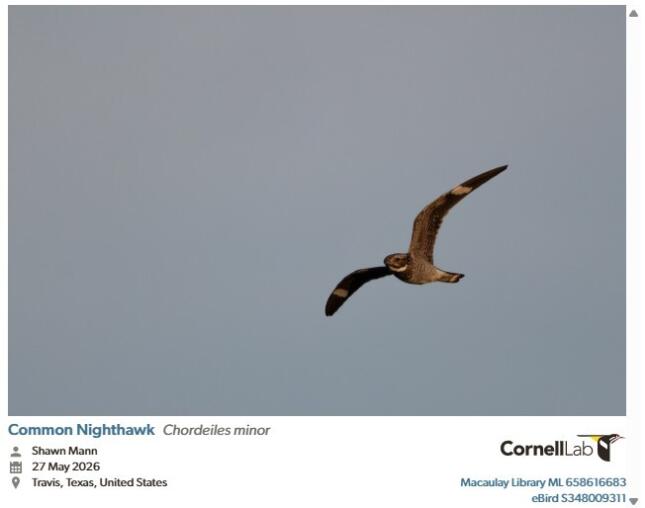
That bird is the Common Nighthawk, a summer migrant that turns open skies into its feeding ground and brings a completely different rhythm to the birdwatching experience.
The Common Nighthawk, scientifically known as Chordeiles minor, is not a hawk at all despite its name. It is a member of the nightjar family, a group of highly specialized aerial insectivores that are most active during low light conditions. Instead of hunting in forests or fields, it hunts the sky itself, relying on exceptional flight agility and an almost effortless ability to twist, stall, and glide through swarms of flying insects.
For a June Bird of the Month, it offers something especially compelling. It is seasonally widely distributed across Colorado, and deeply tied to summer insect abundance. It also challenges many of the assumptions people have about what birds are and how they behave.
Basic Information and Identification
The Common Nighthawk is medium sized, but it often appears larger in flight due to its long, pointed wings and bold wing markings. One of its most distinctive features is a pale white or buffy patch near the middle of each wing. When it banks or changes direction, those patches flash briefly, almost like signals in the dim light.
In direct silhouette, the bird can look falcon-like, but its flight style quickly gives it away. It moves with a buoyant, moth-like quality. Rather than steady wingbeats, it often glides, tilts, and shifts direction in sudden, graceful adjustments. The tail is slightly notched, and the wings are long and narrow with a slight bend that enhances maneuverability.
Coloration is designed for camouflage rather than showiness when perched. When resting on the ground or on a horizontal branch, the bird blends into gravel, bark, or leaf litter remarkably well. This is one of its survival strategies. Instead of fleeing at the first sign of danger, it often relies on stillness and invisibility.
Unlike many birds that are active throughout the day, this species is crepuscular, meaning it is most active at dawn and dusk. In Colorado, the most reliable viewing opportunities come in the evening hours when insects begin to rise and air temperatures are still warm enough to support flight activity.
Habitat and Where to Find It in Colorado
The Common Nighthawk is remarkably adaptable, but it strongly prefers open or semi open landscapes where it can forage freely in the air. In Colorado Springs and surrounding areas, this includes grasslands, prairie edges, open fields, large parks, and even flat gravel rooftops in urban settings.
Historically, these birds nested in natural open areas such as sandy soil, rocky outcrops, or sparse grasslands. Today, they have also adapted to human environments, sometimes nesting on gravel rooftops, construction sites, or other flat surfaces that resemble their natural nesting substrate.
During migration and breeding season, they are widely distributed across much of North America. In Colorado, they typically arrive in late spring and remain through summer before heading south to wintering grounds in South America.
Even when present in good numbers, they can be surprisingly difficult to detect during the day. They rest quietly and rely on camouflage. The real spectacle begins at dusk when they take to the sky in loose, looping flight patterns that can make them look almost like drifting leaves against the fading light. Their mechanical, flat, frog-like note drifting overhead is a dead giveaway for me on summer evenings!
Food Preferences and Feeding Behavior
The Common Nighthawk is an aerial insectivore, meaning its entire diet is composed of flying insects. It does not forage on the ground or in vegetation. Instead, it captures prey while in flight.
Its diet includes a wide variety of insects such as moths, beetles, flies, mosquitoes, and other airborne insects that become abundant during warm months. One of its most important ecological roles is helping regulate insect populations during peak summer activity.
Feeding is often highly efficient and visually fascinating. The bird flies with its mouth open, using a bristle edged bill that helps funnel insects inside while reducing escape. It is capable of quick directional changes and sudden altitude shifts, allowing it to intercept insects that are themselves moving unpredictably.
In some cases, feeding activity is concentrated around artificial lights. Streetlights and parking lot lights attract insects, and nighthawks may take advantage of these concentrated food sources. This behavior can make them unexpectedly visible in urban environments during summer evenings.
Because their diet is so closely tied to insect abundance, their local presence can fluctuate based on weather patterns, temperature shifts, and seasonal insect emergence.
Mating, Courtship, and Nesting Behavior
The breeding behavior of the Common Nighthawk is one of its most fascinating aspects, especially because it is subtle, minimalistic, and highly adapted to open ground nesting.
Courtship typically begins shortly after arrival on breeding grounds in late spring. Males perform aerial displays that are among the most memorable behaviors associated with this species. They fly high into the sky and then dive steeply downward, pulling up just before reaching the ground or treetops. During these dives, air rushing through the wings can create a distinctive booming or whooshing sound. These displays serve both territorial and courtship purposes.
Once a pair forms, nesting is extremely simple. There is no elaborate nest structure. Instead, the female lays eggs directly on the ground or on a flat gravel surface. The “nest” is often just a slight depression in soil, sand, gravel, or roof substrate, sometimes lined with bits of vegetation or small debris, but often bare.
This simplicity is intentional. It helps the eggs blend into the surrounding environment, making them difficult for predators to detect. The female relies heavily on camouflage, remaining still and blending into the ground when incubating.
Eggs are typically two in number, pale in color with speckling that further enhances camouflage. Incubation is shared but primarily performed by the female. The male may roost nearby and assist with territorial defense, but incubation duties fall mostly to the female.
The incubation period lasts roughly 18 to 20 days. During this time, the adult bird is extremely inconspicuous. It will often remain motionless even when approached closely, relying entirely on its camouflage rather than flight.
Once the chicks hatch, they are covered in soft down and are also colored for camouflage. They do not remain in the nest in any traditional sense because there is no raised structure. Instead, they stay in the nesting area and rely on stillness and camouflage.
Parents feed the young regurgitated insects, bringing in a steady supply of protein rich food. Growth is relatively fast, which is important given their exposed nesting strategy.
One of the most remarkable aspects of Common Nighthawk development is how quickly young birds become independent. Fledging typically occurs at about 20 to 25 days of age. Even after leaving the nesting site, juveniles may remain nearby and continue to be fed by the parents for a short period, but independence comes quickly compared to many songbirds.
This rapid development reduces the time that young birds are vulnerable on the ground, an important adaptation for a species that nests in open, exposed locations.
How to Spot Them and When to Look
The best time to observe Common Nighthawks is during warm evenings from late spring through early fall. In Colorado Springs, June is especially reliable because insect activity is high and breeding behavior is underway.
The key is to watch the sky rather than trees or feeders. Look upward over open areas, sports fields, large parking lots, or prairie edges. As daylight fades, scan for irregular flight patterns. Nighthawks do not fly in straight lines or tight flocks. Their movement is loose, drifting, and constantly shifting.
One of the easiest identification cues is their distinctive feeding flight. They often glide for several seconds, then suddenly flick their wings to change direction, followed by a quick burst of flapping.
Listening is just as important as watching. The “peent” call is often the first clue that they are overhead.
Because they are most active at dusk, timing is critical. Arriving just before sunset and staying through twilight increases the chances of a good observation.
Tips for Attracting Them to Your Area
Attracting Common Nighthawks is very different from attracting typical feeder birds, because they do not visit feeders at all. Instead, attraction is about habitat and insect availability.
The most important factor is supporting healthy insect populations. Native plantings that support pollinators, reduced pesticide use, and maintaining natural grassy or open areas can all contribute to a stronger local insect base.
Flat open spaces such as gravel roofs or open fields can sometimes provide potential nesting or resting areas, although direct attraction to nesting sites is not something that can be easily engineered or guaranteed.
What can be influenced more reliably is nighttime insect activity. Minimizing excessive outdoor lighting, especially bright white lights, can reduce artificial disruption of insect and bird behavior. In some cases, softer lighting can encourage more natural foraging patterns.
From a viewing perspective, simply having open sightlines is the most effective way to experience them. A yard that borders open space or has a clear view of the western sky at sunset can become an excellent observation point during summer evenings.
Conservation Concerns and Ecological Importance
The Common Nighthawk has experienced long term population declines across much of its range. While it is still present in many areas, trends suggest significant reductions over recent decades.
Several factors contribute to these declines. Habitat loss is a major issue, particularly the reduction of natural open ground nesting areas. Urban development often eliminates suitable nesting sites or replaces them with surfaces that are too disturbed or unsafe.
Changes in insect populations also play a critical role. Because this species depends entirely on flying insects, declines in insect abundance due to pesticide use, habitat changes, and broader ecological shifts directly impact food availability.
Collisions with vehicles and structures can also affect populations, particularly in urban environments where artificial lighting attracts insects and draws birds into hazardous areas.
Despite these challenges, there is reason for hope. The species shows some adaptability, especially in using rooftops and urban open spaces for nesting. Conservation efforts that focus on insect health, pesticide reduction, and protection of open habitats can have meaningful benefits.
Public awareness is also important. Many people are simply unaware that this bird exists because of its nocturnal habits and subtle presence. Increasing recognition can lead to better conservation support and more thoughtful land management.
Why It Matters in a Backyard Birding Community
The Common Nighthawk brings something unique to backyard birding culture. It expands the definition of what backyard birdwatching can look like. Instead of focusing only on feeders and shrubs, it encourages people to look upward, to pay attention to evening skies, and to notice seasonal shifts in insect life.
It also connects birdwatching to larger ecological patterns. The presence of nighthawks often signals healthy insect activity and functioning ecosystems. Their seasonal arrival marks a shift into the full rhythm of summer.
For anyone who already enjoys feeding and observing birds at close range, this species adds a completely different dimension. It is less about proximity and more about atmosphere, movement, and timing.